The Pedestrian

Will one find it difficult, in the coming weeks, to experience one’s own city as a pedestrian? The term “pedestrian” in elite societies is sometimes “looked down upon,” as against the person who sits smugly inside a four-wheeler and feels the difference. The joy of walking that one had 50 years ago had a social context, as cities were less crowded, had fewer vehicles, and offered plenty of footpath space, or even portions of the road where one could easily walk from Point A to Point B to Point C and back home. Currently, the recent expansion in the ownership and acquisition of vehicles has made it extremely difficult to remain a pedestrian. In today’s terms, a pedestrian is probably neither looked down upon nor even cared for, except that the person who walks is rather isolated. There are 300 helmets if 150 bikes are stopping at a red light, along with four-wheelers and buses separated by dividers, one chooses to walk only when the pedestrian signal turns green. Yet, because of impatience or perhaps frustration, the pedestrian has little chance against these behemoths, and all the two-wheeler drivers are hidden behind visors. That leaves me wiser to the reality that I should quickly negotiate between four or six vehicles by holding up my left or right hand to indicate that I am legitimately crossing at a zebra crossing – sauntering across stripes that are themselves almost invisible because they wear out faster than the city authorities can muster the resources to repaint them. The complication is similar at road humps, where stripes are also supposed to exist but are sadly missing for the same reason: both the humps and the paint wear out quickly. The city traffic police are definitely a stoic lot, or perhaps a harassed lot, though they rarely show their harassment or frustration. The sheer authority of the khaki uniform, the white shirt, and the whistle remains. Sometimes they carry sticks and caps as part of standard issue, or even wear helmets because they may immediately have to rush on their own bikes to the next junction when the radio hoisted on their shoulders signals a problem or crisis at another location. They have to contend with indifferent drivers, riders, pillion riders, and pedestrians who scurry across roads. Yet, during traffic jams, it becomes strangely convenient to test the agility of our heels and knees while leaning toward or away from rear-view mirrors, all the while remaining conscious and aware of riders so as not to embarrass ourselves. There is often a wondering look as to why I should be a pedestrian at all, and my dear friend who chooses to walk in the early mornings gently reminds me to take care. The true adage in management is that a manager should measure what one manages. So, managing to remain a pedestrian, I thought, would perhaps be the best way to increase awareness, contemplation, and meditation in the current world – something that seems impossible merely by reading or checking media. So-called negativity is overwhelming, only lightly balanced by positivity from do-gooders who quantify and prescribe how one should live life here and now. The pedestrian, however, exists in the here and now. It is the driver, rider, and passengers whose lives are placed in the command of the person behind the steering wheel. How a person responds to another who overtakes from the left or veers recklessly through traffic because it is time to reach the college bell reflects the current condition of society. This is the present mode of life, where one must place a thumb on digital time recorders whose summaries go to the HR chief, or the delegate of the HR chief. Strict monitoring of time also enables ERP systems to deduct salaries proportionate to the minutes one is absent from the office. How does all this affect a quiet village, where time once seemed to rest gently in one’s hands? More and more employment now draws villagers into cities and back again, as commuting from rural areas becomes part of modern life after they equip themselves with the competencies needed for city jobs. In a village, being a pedestrian was once very easy. It was always my favourite thought that I could simply lounge around in a village. But with current levels of prosperity, village roads too are lined with parked vehicles – from brand new cars to second-hand ones. It is surprising that the amicable rivalry between villages and cities is slowly transforming into affection, nostalgia, and the genuine ability to say that one can still be happy by visiting one’s own village. There, one meets villagers who are friends or relatives and enjoys the quietude for a few hours. The quality of village life is overwhelmingly better than the exhausting travels of cities, whether they are Tier 1, Tier 2, or Tier 3. City corporations and town municipalities alike ultimately serve only one Indian citizen who must constantly figure out how he or she will commute.

Gurpur Valley and the Foothills of the Western Ghats

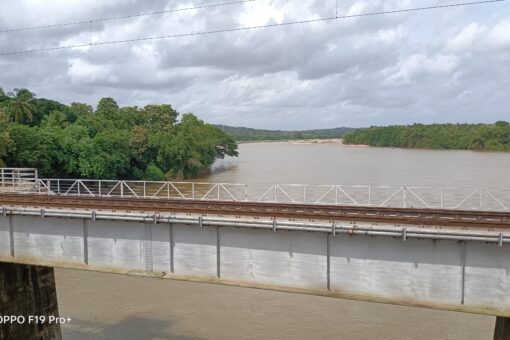
A Landslide, A Community, and a Lesson in Living with Nature There was a landslide between Vamanjur and the bridge – a block on a road that is now being developed as a National Highway. At that time, however, it was a State Highway, before being handed over to the National Highways Authority (NHAI). The landslide occurred in July after heavy rains, and the evidence can still be seen today: a major slice of the hill had collapsed. On top of that hill stands a primary school, now painted like a railway bogey. As a result, all of us from Mangalore, as well as those from Moodbidri, were prevented from reaching Gurpur. Likewise, all the residents beyond that point were affected. Buses had to be diverted via Bajpe. More than a hundred express and other buses began using the diversion route, increasing travel distances by approximately 6 to 9, and in some cases even 12 to 14 kilometres per trip. At that time, there were clay lorries transporting clay, but the majority were river sand lorries. Consequently, the transportation of stones, sand, and other materials was disrupted, and all traffic moving from Moodbidri towards Mangalore city was blocked. A Minister’s Swift Response Shri B. A. Moideen, the Honorable Minister in charge of the area, immediately visited the site, surveyed the situation, and ordered experts from Bangalore to examine it. In those days, resources such as excavators and large trucks were not readily available. For the next 48 hours, newspapers carried headlines, surveys were conducted, and discussions took place regarding how best to deal with the situation. The lorry owners made it clear that they could not simply increase their charges because of the diversion through Bajpe. Bus operators also emphasized the need to restore the road as quickly as possible. Volunteers Each lorry owner contributed a vehicle, and labourers immediately began excavating the mud and dumping it at suitable locations. Within 24 hours, a pathway sufficient for movement had been created. An important aspect of the story is that measures were simultaneously taken to ensure that no further landslides would occur. Because of this incident, important decisions were made both in Bangalore and at the district headquarters. It was truly a remarkable sight, and residents of Gurpur who witnessed it will recall that the entire effort was voluntary – it was said that not even a single rupee of government money was spent. The work was carried out by about 3,000 volunteers and paid workers who joined together to clear the road. This nearby landslide story therefore remains highly relevant even today. Why This Story Still Matters Its relevance lies in the lesson that we should not disturb the ecology of the Gurpur Valley, or any other valley in Dakshina Kannada, unnecessarily. The principle involved is terracing. Many of us have travelled on the Konkan Railway and observed that monsoon schedules differ from regular schedules. The travel time of the Matsyagandha Express increases by nearly three hours during the rainy season. However, the Konkan Railway has addressed landslide risks differently by introducing terracing along vulnerable embankments. Similarly, throughout the foothills extending up to Karwar, one can observe extensive terracing undertaken along the National Highway. When limestone, laterite (“shady,” as we call it locally), or loose soil is cut vertically for heights ranging from 30 to 80 metres, landslides become almost inevitable. Therefore, as human beings, we must apply ingenuity and practical solutions at the lowest possible cost. Micro-Engineering for a Beautiful Valley We should adopt micro-engineering solutions in Gurpur and nearby areas so that our beautiful valley can remain naturally preserved, even when practical issues such as two- or three-metre variations in water stagnation levels arise. What we need is practical engineering. Practicality does not mean relying exclusively on local resources. With a minimal quantity of cement or reinforced concrete, scientifically applied, structures can remain stable and effective for fifty years or more. For example, the steps constructed in 1958 during the Punar Pratishtha remain intact even today. This is not merely because of sound engineering; it is also because they were built with affection, dedication, attention, and care. Every stone was carefully crafted with longevity in mind. Laterite, a natural building material abundant in this region, hardens over time. Excavating and demolishing laterite structures is generally not a good idea, but people often do not listen. They seek modernity through demolition and reconstruction. Anything can be demolished; rebuilding well is the real challenge. A Request Therefore, I thank everyone for their attention and request each person to contribute, however modestly. The contribution need not be financial; it can simply be attention, care, and concern. Once a place becomes beautiful, people naturally appreciate it. However, that is not the main objective. The primary goal is to make it convenient and livable for all of us. Villages are the Future Some people may even choose to live in villages because they offer a quality of peace and tranquility that is difficult to find elsewhere. This is not only about the temple, the mosque, or the church. Villages are good places to live because they provide peace, lower levels of pollution, and higher levels of oxygen – even if the difference is only one or two percent. Village life represents the future of India, especially when villages can also offer broadband connectivity, good-quality food, and opportunities for people to sit together and engage in meaningful conversations. Gurpur is going to be great!

Phalguni Institute of Nature and Ecology

Phalguni Institute of Nature and Ecology (PINE) can be established for the purpose of promoting the growth of flora and fauna in Dakshina Kannada. In the nation of Bharat, in Sanskrit, it is referred to as sasya and syamala. The evolution of prakriti, which refers to the modifications in all beings, plants, trees, and all related areas in practical terms, needs to be allowed to bloom. Indian soil, in its diversity, accommodates all varieties of plants. This is amazing, and this includes water management, the ability to work with one’s own hands and feet, and the application of the joys of sight, sound, touch, feel, and taste. In the Phalguni Basin, which in its course ends in the city of Mangalore, the river flows through the city and encircles it. It joins the Netravati River at the delta. This river is 83 kilometres long, originating from the Western Ghats, and its riverbanks will need to flourish with nature and ecology, without intrusion from pollution or man-made atrocities against nature. The broad aim of PINE is: a. To promote the Phalguni River Authority; b. To protect the River Banks agenda by encouraging alternatives to land-bank methodologies and invoking ecological depositaries and nature enclaves; c. The construction of local habitats that are suitable for enjoying all the seasons of the year; d. To construct piers dynamically and facilitate moderate and safe boating; e. To adapt to the seasons, in the Indian context of ritu. They are: – the summer season, – the rainy season, – the harvest season, – the cool and cold season, and – the spring season. Temperatures remain moderate around the year in the Coastal Karnataka region. Mild weather attracts human beings to interact more with nature than with extremes, as extreme cold and extreme heat are not present in our region. Augmentation will happen when there is abundant growth of vegetation. No part of the earth should be left without tree or plant cover, thereby enabling the ecology to improve and allowing small plants and trees to absorb the carbon dioxide generated by all forms of emissions from mechanical and fuel-driven devices or equipment. Every portion of the area can be utilised for small affordable homes. Materials, labour, and tools can combine to produce the requirements of vegetables, coconuts, and all nuts grown within the region. Local vegetables that can be adopted for consumption in all edible forms may be encouraged. The theme “Buy Local” will be encouraged to promote good consumption practices. Avoiding the use of materials or media that may adversely affect the ecological system can also be encouraged.