
Strengthening India Post and the Indian Postal Bank

A Proposal for National Integration and Financial Inclusion India Post stands tall as one of the nation’s most respected institutions — an organisation of national reckoning that touches every citizen from birth to death. It continues to be a trusted carrier of information and a symbol of integration across the country. This proposal seeks to strengthen both India Post and the Indian Postal Bank, transforming them into the backbone of communication, savings, and financial access for every citizen. Summary of the Proposal All postal services should operate on a true cost basis with a 15% surplus, ensuring efficiency and sustainability. The India Postal Bank must serve every citizen, ensuring universal access to banking. India Post can further national integration by offering authentic translation services of laws, rules, and gazettes in all official languages. Every government and official building should provide currency deposit and withdrawal facilities, for both Indian and international currencies. Railway Stations should become hubs for Postal Bank and Postal Services, reviving the spirit of the Railway Mail Service through a modern hub-and-spoke model. The Reserve Bank of India (RBI) may handle all coins and currency from mints and presses, while Postal Banks at railway stations act as currency chests and distribution hubs. India Post may lease BSNL and other government properties for approved official services. The Postal Bank must be compensated for services provided to government agencies. The Postal Services Board can expand into “India Communication Services”, creating new cadres and employment opportunities. Collaboration with the RBI and international postal systems can strengthen communication and currency exchange infrastructure. Postal Services Board Proposal The RBI should be the sole handler of coins and currency, managing chests for all banking entities on a correspondent basis. Every financial institution should open a current account with the Postal Bank solely for cash supply and absorption. The Indian Postal Bank should function as India’s largest narrow bank — collecting savings, offering 0% current accounts and nominal-interest savings accounts, without lending to individuals or institutions. It invests exclusively in central government securities. The Postal Bank can sustain 1.75 lakh employees by collecting savings, disbursing cash, and operating under transparent, fee-based regulations. Expansion of Functions India Post may lease BSNL and government properties to handle approved activities of institutions such as the Election Commission, Parliament Secretariat, Judiciary, and others. The Postal Board can engage UPSC applicants, apprentices, and trainees, especially those preparing for public administration, in structured programs. Within the Parliament Complex, the Postal Board can act as an official communication channel for the Lok Sabha Secretariat, Rajya Sabha Secretariat, Election Commission, Finance Commission, and all constitutional bodies. The Postal Bank should be compensated for all services rendered to government agencies operating on its premises. Development of New Cadres The Postal Services Board can evolve into India Communication Services, creating new cadres through UPSC or direct recruitment. This Cabinet-approved personnel reform can generate large-scale employment while integrating communication and administrative functions across institutions. A multilingual national communication backbone can emerge — using all 23 constitutional languages — positioning India Post as the nation’s authentic communication channel. India Post can serve as the official translator for courts, ensuring accessibility and accuracy in every language. Every government office should host a Post Office counter as a familiar citizen interface, reinforcing India Post’s role as the bridge between people and the State. Collaboration with RBI and International Linkages The Postal Services Board can manage RBI’s backend infrastructure, ensuring citizens’ easy access to the Postal Savings Bank. It can facilitate currency exchange for foreign visitors and during emergencies such as hospital needs or national disasters. Through the Universal Postal Union, India Post can represent India globally — training staff abroad and managing embassy-level communication systems. Personnel Management The Indian Postal Bank, under the Indian Postal Service, should become a channel of national integration and trust. Every railway station should host a secure, well-built postal counter that accepts cash and checks from anyone within its jurisdiction. Each station should have three service counters – outside, inside but before the platform, and within the platform area. Cash deposit machines and ATMs will be installed near parking areas, ensuring convenience for local merchants. This will mean around 24,000 Postal Bank counters across India and 100,000 deposit machines serving railway and transport hubs. Post offices will also handle bus ticket counters, integrating postal and transport functions. The idea is “banking on the go”, enabling merchants to deposit daily collections easily. Postal Banks should operate from 6 AM to 10 PM, with employees working efficient four-hour counter shifts. The RBI should ensure two ATMs per station, distributing new notes and coins in eco-friendly packaging. Around 1.75 lakh employees will manage currency operations, with full access to social security and benefits, ensuring dignity of labour. Employment and Recruitment Anyone aged 21–70 years can opt for part-time or full-time work if they reside within 1–2 km of their assigned post. The proposed workforce includes 1.75 lakh Junior and Senior Officers, recruited through UPSC or direct entry. Work shifts will be organised into four rotations, each lasting four hours. With over 40,000 bus and railway stations, total employment could reach 8 lakh individuals. Students and young people above 18 years can join under an “Earn While You Learn” scheme. A two-year apprenticeship will prepare workers for wider government roles, contributing to a national skills registry. Operations and Expansion The Indian Postal Bank can operate in airports in partnership with the Airport Authority of India. The RBI can authorise it as the sole evacuator of currency from mints and presses to stations and cities. Commercial banks would no longer need to maintain currency chests, as Postal Banks will handle cash logistics securely. With protection from Railway and State Police, every major station can house Postal Bank ATMs and deposit machines.New ₹300 and ₹400 notes may be introduced — ₹300 for farmers and ₹400 as a symbolic wage for security personnel. Express trains could carry Postal Bank compartments for the safe and quick transfer of currency. Integration with state transport cooperatives will strengthen cash movement and public convenience. Conclusion The Indian Postal Bank will maintain strong daily cash flows, mobilising savings automatically from all sectors. With railway stations, bus depots, and airports serving as active financial hubs, this network will create new growth pathways for India. Together, India Post and the Indian Postal Bank can unite communication, finance, and service — generating jobs, ensuring inclusion, and securing the nation’s currency system, all while reaffirming India Post’s role as a true symbol of trust and integration.

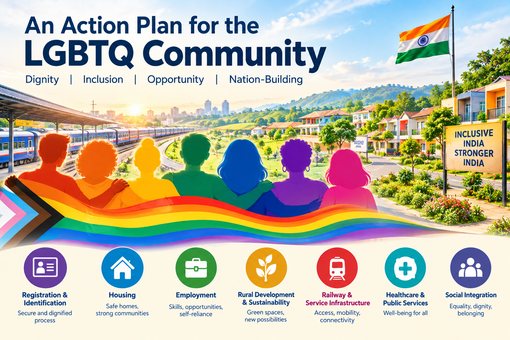
An Action Plan for the LGBTQ Community

Introduction It is a good augury that the Head of the Civil Services is leading a Committee to generate alternatives, as requested by the Supreme Court of India. The Government of India needs to have an action plan for the LGBTQ community. The following are some points for consideration in developing a practical action plan. Registration, Identification and Institutional Responsibility A proposed action plan for the Government of India to promote dignity, housing, employment, economic integration and access to services for the LGBTQ community, while developing rural and semi-urban The Government of India – Cabinet will decide on a registration process, and the agency for handling this will be the IRCTC (Indian Railway Catering & Tourism Corporation), as it has the capacity for capturing all the data and identification. This shall be supported by an annual budget of ₹300 crores, limited to the next 3 years, as a confidential internal portal for the Government of India to handle it. For the purposes of identification, the Government of India will take sole responsibility. The registration process will be under a portal which will be shared with all State Governments and their agencies, so that they can take cognizance. a. To identify every case, individuals can register in a simple format, consistent with the dignity of the individual prescribed in the Preamble of the Constitution, which the Government of India recognizes. In the case of gays, whether female or male, the elimination of social discrimination they face will be a gradual process that will take time. b. The Government of India shall appoint BSNL as a corporate agency to generate alternatives. c. The support will come from the Ministry of Social Justice. d. The Government of India can provide an initial grant of ₹5,000 crores, not for expenditure but for capital investment in quality homes where transgenders can live. This can be with property rights on a lease-cum-sale basis. e. The ideal place for this is fresh land to be identified between National Highways and Railway Stations. f. The State Governments can be requested to speedily make available pockets of land, which need not be very large in number but should be connected to a railway station. As railway stations have access to city-sides, village-sides and countrysides, the areas particularly connecting to National Highways in suburban, rural and other parts can be developed into suburbia, with opportunities that can help decongest cities as well. 700 such pockets can be identified, with pieces of land converted into row houses, mini houses or apartments, as preferred by the community. This would demonstrate integration, not isolation. Recommendations for a National Population Commission The Government of India will initiate an Indian Population Commission with due process and parliamentary and legislative approvals. The Indian Postal Service shall be expanded to the Indian Population Service, with an annual intake of 40 officers. The Union Public Service Commission will be requested to initiate the process from applicants for the services already made in the last 5 years and create a new curriculum and process for appointments by January 1, 2025. The cadre shall be called the Indian Population and Census Service. Thirty existing members from the services will be drawn to form the Indian Population Commission, which shall be headed by a service-rank official of the rank of Secretary, Government of India. Retired or any gazetted officer of the Indian Union from the last 20 years, up to the age of 70, pensioners and serving personnel who wish to volunteer for this assignment of the Indian Population Commission will be empanelled and registered with BSNL. The mission is to register every Indian into the Indian Population Register in a simple format, expandable from all the databases in the nation. In the medium term (5 years), all LGBTQ individuals will be provided with housing at costs built by the community, rendering them acceptable. They will be given plots at cost with an instalment plan of 30 years. Employment and earning opportunities will be provided not only to them but to any member of the community willing to work hard or smart and contribute to nation-building. This programme will be entirely borne by the Central Government with its own resources. To this extent, the MGNREGA programme will be withdrawn effective from the financial year 2025, and 50% of the current year’s allocation will be made towards building assets on Central Government property to meet the needs of social justice. Development Objectives: Rural Areas, Ecology and Enterprise The following objectives will prevail: a. Rural development Development in rural areas, particularly the sections between any National Highway connecting to any railway station. b. Ecology and biodiversity The ecology will ensure that at least 50% of the area will be for ecology and biodiversity, preserving and maintaining existing green spaces. This will be developed by the community within the region, making it hospitable for people anywhere in India who are living on rent to build their own homes. The plans will be conducive to building homes with provisions for renting accommodation to any member of the community in India who chooses to migrate to such locations. c. Enterprise parks and employment Enterprise parks will be located next to these areas, encouraging enterprises to start or relocate from congested cities, meeting State and national employment creation objectives, with a minimum earning wage of ₹400 for 4 hours of productive work, particularly adding value to our agriculture and agribusinesses. The sole objective of this exercise is to bring all kinds of waste in the current agricultural ecology to zero. This includes the complete mobilization of national resources in animal husbandry, poultry and any related activity, including the husbandry of stray animals, especially those from crowded cities. Eventually, the balance between rural, semi-urban and urban needs to be harmonious, and to this extent, members of the LGBTQ community will contribute to the national endeavour. Currency Management, Banking and Employment Generation In the first instance, the Reserve Bank of India or its agency needs to join the process in the registration for developing them into agents of change. The Reserve Bank of India is directed to ensure that no currency is spoiled or mutilated, with handling done entirely by this community at special locations of at least 900 facilities, manned by temporary employees from this community for 4 hours a day. The Reserve Bank of India shall invest in the security of this operation, supported by the community and the especially nominated agency, which will be the Grameen Banks. The Grameen Banks will be directed to have currency chests next to railway stations. Currency movement will always be on railway platforms in specially designed coaches attached to all passenger and express trains. All circulating coins will be managed through this mechanism. The Ministry of Economic Affairs will handle the distribution of currencies from the currency press and mints solely to the Indian Postal Bank and the Grameen Banks. The Reserve Bank of India and the Government of India will ensure that freshly minted coins and currency are managed and issued from 1,800 railway platforms of India, drawn by commercial banks and the Indian Postal Banks at all their counters across the country. The Government of India shall draw on the resources of retired BSNL personnel or voluntary service to develop standard operating procedures and systems, ensuring the smooth flow of currency. All land belonging to the Department of Communication shall be handed over on a 30-year lease to the Department of Railways. Railway Centres and Infrastructure The Department of Railways shall convert these centres into: Currency chests: For circulation within respective communities. Organizing towers: To capture satellite or telephony signals, enabling employment generation through indirect services for 12 hours a day, in 4-hour shifts. Employment and initial training: Any person desiring employment will be provided with 2 hours of training and 2 hours of initial work, expandable to 4 hours. Such persons can leave their jobs for higher-value employment or self-employment once this process is started. Initial employment phase: In the initial phase, 240,000 women aged 18 to 24 will get open employment for 4 hours, along with scholarships to learn and earn in the next 4 hours. This experience-based approach will bring dignity and employment to any woman from age 18 for the rest of their lives, enabling services to the Indian community. Electricity charging points: The next phase involves setting up electricity charging points for two-wheelers, manned by this community every 10 kilometers in areas not utilized by proper sanitary landfills, legitimized through State Government agencies. Rural distribution: The Indian Railways can participate in this programme by tapping rural areas for coins, currency availability and basic essentials, legitimized through a formal takeover mechanism. Bharat Canteen Stores and Public Health The Ministry of Defence can be encouraged to establish Bharat Canteen Stores, not as ration shops but as 5/11 stores, providing processed food or equivalent from 5:00 AM to 11:00 PM, with nearby hygiene and sanitation facilities. This programme will integrate the National Health Programme. AIIMS, ESI Hospitals and Railway Hospitals can be modernized and expanded, providing the Queer Committee with medical access insured by national insurers. Every railway station will have a micro-hospital at the connection between the civil and State sides, with paid toilets, demonstrating the capability of railway stations to handle flux at any national agency for productive and employment growth. This initiative can create 2 crore jobs, generating 800 crore hours of productivity daily, making services more accessible. A National Mission to Eliminate Waste and Improve Productivity The famous term, “Waste is an activity that does not produce results,” will be transformed into a system with no additional waste of time for accessing services, translating into achievements over 10 years. The Government of India must adopt a catalytic rather than a control approach in building the economy to world standards by 2035. Marriage, Housing and Social Integration The Committee needs to recommend that the denial of married status to any same-gender couple is not feasible for at least 10 years under current circumstances. Special permission should be granted under the Marriage Act to permit “living together.” Single-occupancy housing is feasible for all transgender individuals or equivalents, with rental payments on social contributions or CSR equivalents on Central Government-managed properties, in cooperation with all State Governments. Voter registration will be supported by the Central Election Commission, with normal or extended facilities granted. Conclusion The Indian nation can accept all citizens, and integration will be a matter of time. The action plan envisages dignity, housing, employment, access to public services, economic participation and the development of rural and semi-urban India. Its central objective is to enable members of the LGBTQ community to contribute to nation-building while ensuring that integration, rather than isolation, guides the process. Sent to the Cabinet Secretary on 8th June 2024